Manali to Leh Motorcycle Tour: The 2026 Route, Passes, and What to Pack
The Manali to Leh motorcycle tour is the Himalayan ride most people picture first. Here is the route, the passes, and what a guided Ladakh departure actually feels like.
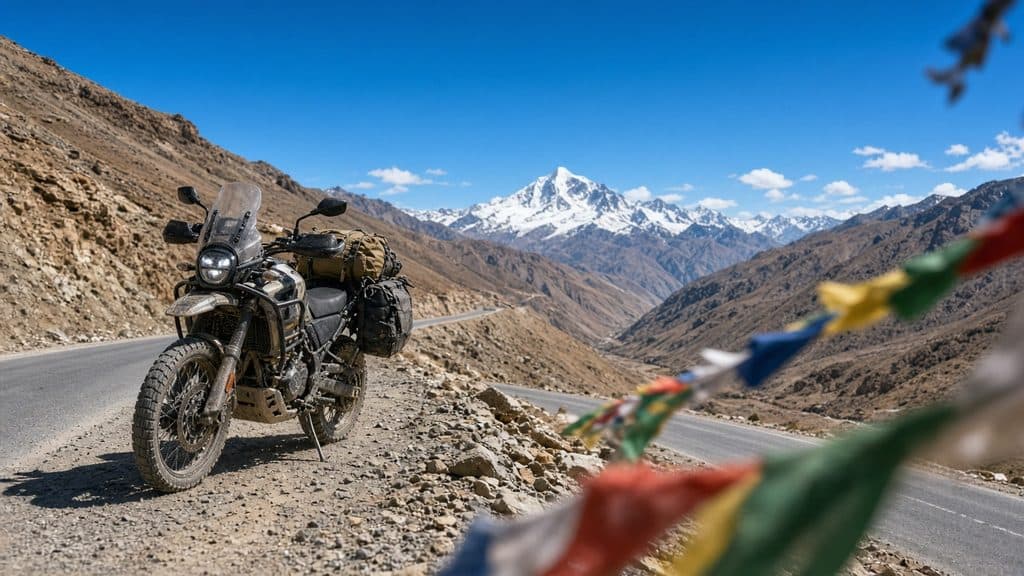
The Manali to Leh motorcycle tour is the high road of the Indian Himalaya: the Atal Tunnel, Lahaul, Baralacha La, the Gata Loops, Lachulung La, the More Plains and Tanglang La, before the Indus valley opens into Leh. Ridden properly, it is about two weeks, not a three-day dash.
Hardev Motors has guided motorcycle tours from Vashisht, Manali, since 1985. The Leh Ladakh bike trip is still the departure guests ask about first. On the published mountain rides the motorcycle is a Royal Enfield Himalayan scram 411, prepared in Manali, with a crew that already knows where the day should stop. This guide is the practical version of that road: what you actually ride, how altitude behaves, what to pack, and where a guided Ladakh motorcycle tour is worth more than a downloaded GPX file.
Why this road is different from a normal tour
Most touring roads reward you with corners or coast. This one rewards you with height. After the Atal Tunnel you are already in a different climate from the Kullu valley, and by the second night you are sleeping higher than many riders have ever been. The riding itself is not a racetrack. Long sections are broken tarmac, gravel patches, water crossings in early season, and slow climbs where third gear is plenty. The difficulty is the combination: cold, thin air, distance, and a road that changes after every storm.
A rushed Manali to Leh motorcycle tour is how people collect a photograph and a headache. The highway can be covered in three very long days by riders who already know it. That version skips the reason for coming. Leh, Nubra and Pangong need time of their own, and your body needs a night that is not spent climbing. Two weeks is the length that still feels like a holiday.
The route, pass by pass
You leave Manali and climb out of orchards and pine into the approach to the Atal Tunnel. The tunnel removed the old compulsory crawl over Rohtang for through-traffic, but it did not flatten the Himalaya. On the far side you drop into Lahaul: Sissu, then the Chandra valley toward Keylong and Jispa. This is the last stretch that still feels like Himachal. Rooms are simpler than Manali, food is dal and rice done properly, and the evening temperature has already fallen.
From Jispa and Darcha the road commits to Baralacha La, about 4,890 metres. This is the pass that decides early-season departures. Snow, a blocked cutting, or a convoy stuck on the south side are normal in June and not a personal failure. The north side drops toward Sarchu, on the border of Himachal and Ladakh. Sarchu looks flat and harmless. It is one of the worst places on the route to spend a careless night, because you have gained altitude quickly and the plain is cold after dark. A guided group stops here because the road requires it, not because it is comfortable. Drink water, eat, and do not treat it like a party.
North of Sarchu the road climbs the Gata Loops, a stack of hairpins that looks worse in photos than it rides if you are patient. Nakee La comes next, then Lachulung La, a little over 5,000 metres, before the descent to Pang. The More Plains after Pang are the mental break: a long, pale, almost empty runway of road where you finally stop staring at the next bend. Tanglang La, about 5,300 metres, is the last great height. The descent toward Upshi and the Indus is where riders start smiling again. Leh is still a little further, and it should feel like an arrival, not another fuel stop you ride through.
What to do once you reach Leh
Leh is for acclimatising, laundry, a proper meal, and the side trips that make a Ladakh ride complete. The two that matter for most first visits are Nubra and Pangong. Nubra takes you over Khardung La toward Diskit and the dunes at Hunder. Pangong is a long day there and a long day back, and it is worth it when the light is on the water. Doing both, plus a rest day in Leh, is why the itinerary cannot be a weekend.
Khardung La is busy, high, and often colder than the forecast in Leh suggested that morning. Ride it as a crossing, not as a place to linger without a jacket. The old signboard height is optimistic. The road is still serious. Monasteries in and around Leh, Thiksey and Hemis among them, are the right use of a slower afternoon. A Royal Enfield Ladakh tour that never gets off the bike has missed half the place.
Riding months, honestly
June is when a Manali to Leh motorcycle tour usually becomes possible, not when it becomes easy. Baralacha can still be holding snow, and a guided departure in early June should be sold with that sentence attached. July and August are the stable core of the season. The road is open, the days are long, and you will share the More Plains with other groups. September is colder and quieter. Early September is often the best riding of the year. Late September depends on the forecast over Baralacha, and October is not a plan for this highway.
The Atal Tunnel keeps the Manali side usable outside that window. It does not keep Tanglang La open. If a listing promises the full high road in winter, it is describing a different trip.
Altitude, in practical terms
Acute mountain sickness is common enough on this route that you should know it before you need it. A headache, nausea, unusual fatigue, poor sleep or a step-change in how you feel after gaining height are signals, not badges. The fix is to stop climbing, rest, tell the guide, and descend if it gets worse. Diamox is a conversation for your own doctor before you fly, not a tip from a stranger on the internet. Alcohol at Sarchu is a bad idea. So is a heavy dinner followed by a plan to ride at dawn as if nothing happened.
The pacing that works is boring and effective. Sleep lower when the itinerary allows it. Drink through the day, not only at dinner. Do not race the group to the top of a pass to take the photograph first. On a guided Ladakh motorcycle tour the day already has a height plan. Trust it.
The bike, the luggage, and the support
Hardev runs these mountain days on the Royal Enfield Himalayan scram 411. It has the stance and the gearing for slow, rough climbs, and it is the motorcycle the Manali workshop already knows how to keep in the field. You do not need to ship a bike from home for one season. You do need to be comfortable riding for several hours, including on broken surfaces.
Pack for the bike, not for a resort. Soft luggage that can be strapped beats a hard case that changes how the Himalayan leans. A rain shell lives on top of the bag, not at the bottom. The same is true of a warm layer. Weather on Baralacha and weather in Leh on the same afternoon are not related. Backup support on a Hardev departure is there so a puncture or a tired rider is a delay, not the end of the holiday. It is not there to ride the pass for you.
What belongs in the kit
- A helmet you have already worn for a long day, plus a buff and sunglasses.
- Two pairs of gloves: one you can feel the levers through, and a warmer pair for the passes.
- Riding boots you can walk in. You will walk.
- A waterproof shell, a light insulated jacket, and base layers. Evenings at Sarchu and Pang are cold in every summer month.
- Personal medicines in the original packet, any altitude advice from your doctor, and a small blister kit.
- Passport, the permit papers the crew asks for, and a second copy of both. Inner Line Permit rules for protected areas of Ladakh differ for Indian and foreign guests and they change. On a guided departure, Hardev handles the paperwork the route needs. Do not rebuild it from an old forum post.
- Cash. Card machines and signal both disappear for long stretches of Lahaul and the high road.
Mistakes that waste the trip
The first is booking flights that assume the road will run like a motorway. Build a spare day on either end of Leh. The second is starting the tour already exhausted from a red-eye into Delhi and a night bus. Bhuntar, the airport for Kullu and Manali, is the kinder arrival if the flights work. The third is copying a record attempt. Average speed on this road is a vanity number. The fourth is ignoring a headache because the group is moving. Say something at breakfast.
If the full Manali to Leh line plus Nubra and Pangong is the trip you want, look at the 2026 fixed dates rather than inventing a self-supported week. Divine Zanskar + Leh is the longer Hardev expedition when you want Padum as well as Leh. Spiti Behind The Scenes is the better first high-mountain ride if Ladakh still feels like too much height for this year.
Frequently Asked Questions
How many days should a Manali to Leh motorcycle tour take?
Is the Royal Enfield Himalayan enough for Ladakh?
When is the road actually open?
Do I need previous high-altitude experience?
Can I ride my own bike?
Dates and prices for the coming season are on the 2026 fixed departures calendar. If you want a route built around your dates, tell the Hardev Motors team in Manali and they will plan the ride with you.