
Rajasthan Motorcycle Tour Itinerary: Forts, Desert Roads, and a 15-Day Ride
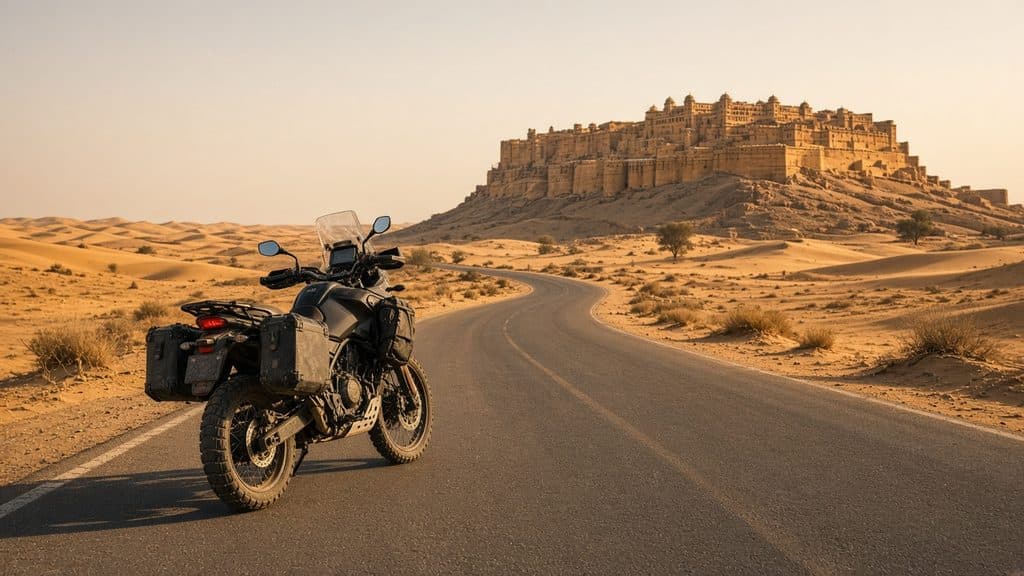
A Rajasthan motorcycle tour is the winter ride: heritage towns, long desert highways, and a Royal Enfield day that ends at a fort instead of a pass.
A guided Rajasthan motorcycle tour is the winter ride: long desert highways, fort cities, and a day that ends at a haveli instead of a high pass. Fifteen days is enough to cross the state without turning the holiday into a parade of loading the bike.
Hardev Motors runs this as Glimpse of Rajasthan. On the 2026 calendar the departures sit in January, February, March, November and December, listed from 2,500 dollars for the rider with a Royal Enfield Himalayan, and nights in heritage and deluxe hotels. This guide explains the landscape those days move through, how winter riding actually feels, and what to practise before you arrive. It is not a fake hour-by-hour of towns the operator may sequence differently each year. The published departure is the itinerary. The geography below is so you understand the country you are crossing.
Why winter, and only winter
Rajasthan in May is a furnace with forts in it. By April a full riding day is already hotter than most visitors expect, and the light that looks golden in a photograph is attached to a helmet that does not breathe. November through March is the season, which is why those are the months on the Hardev calendar. Mornings in the desert can be genuinely cold. Afternoons are warm and rideable. That range is the whole packing list: a light jacket you will wear at dawn and strap to the bag by 11.
If your only dates are in July, ride Spiti or Ladakh and keep Rajasthan for a later year. Do not try to out-tough the Thar. The bike will run. You will not enjoy it.
The country the ride moves through
A Jaipur Jaisalmer motorcycle tour that tries to see every city becomes a sequence of transfers. A proper fortnight picks a line. Jaipur is the large, busy, pink-sandstone start many groups use, and it is where you learn that Indian city traffic is a skill, not a personality test. Pushkar and the smaller towns reward a slower afternoon. Jodhpur brings the fort above the blue city and a riding day that finally opens out. Jaisalmer is the desert capital: the fort in the middle of town, and the highways that run toward the Thar with very little else on them.
Bikaner, the Shekhawati painted towns, Udaipur and the Aravalli hills are the other classic pieces of a Rajasthan motorcycle tour, and not every fortnight includes all of them. That is a virtue. Palaces are the reward at the end of the day. The ride between them is the tour. When you read the current Glimpse of Rajasthan week, look at how many nights you actually sleep in each place. One night everywhere is a delivery route. Two nights in one desert city is a holiday.
What a Thar Desert day is really like
The desert riding day is long, pale and surprisingly cold at the start. The road is mostly sealed. Wind is the main event, not dunes in the carriageway. Camels and sand are there if the itinerary stops for them, and they are optional colour, not the substance. The better memory is usually an empty highway, a truck you have learned to read, and a town that appears all at once on the horizon.
You do not need knobbly tyres. You do need patience in the cities, where the first hour of any day is slower than the map suggests. Cows, camels, unmarked speed breakers, and vehicles that pull out without a glance are the hazards. A guided Rajasthan bike trip sets the pace for that, not for a racetrack average. Ride in the morning. Leave the hottest, dustiest hour for lunch.
Riding skills that matter more than horsepower
The Himalayan will feel almost easy on these highways after a week in the mountains, which is why Rajasthan is a popular second trip and also a reasonable first India tour for riders who are already happy in traffic. The test is attention, not balance on gravel. Look far ahead. Cover the brake. Expect every junction to contain a surprise. Do not ride at dusk if you can avoid it. Unlit bullock carts and trucks without tail lights are a real part of rural nights, and they are a bad match for a tired rider.
If Indian roads are new to you, say so when you enquire. The first city day can be used properly instead of being a shock. Hardev’s crew is used to guests who ride well at home and have never filtered a Jaipur roundabout. They are less able to help a guest who pretended otherwise.
Hotels, food and the practical kit
Heritage and deluxe hotels are part of what you are paying for on this departure, and they are the right call. After 250 kilometres you want a shower that works and a courtyard, not a test of character. Food is a pleasure of the state: eat the thali, be sensible with street snacks on the first two days if your stomach is new to the spice, and drink bottled water. A buff, sunglasses, a light jacket, riding jeans you trust, and boots you can walk a fort in will cover the clothing. Sunscreen matters more here than on a cold pass. So does a spare pair of gloves if the morning wind is bitter.
- A photocopy of your passport and the riding documents the team asks for, stored separately from the originals.
- Cash for small towns, even though cards work better here than in Pangi.
- A daypack for fort steps. You will not want the riding jacket in a palace at noon.
- Any personal medicine. Pharmacies exist in the cities and should not be your plan for a prescription you already know you need.
How this pairs with a Himalayan year
Rajasthan does not compete with Ladakh for the calendar. Riders who can travel twice often do Glimpse of Rajasthan in winter and Divine Zanskar + Leh or Spiti in summer. The bike is the same family of Royal Enfield. The country is the opposite, which is why the second trip does not feel like a repeat. If you only have one journey, choose by season and by temperament. Forts and desert highways, or high passes and cold mornings. Both are worth doing properly. Neither is a consolation prize.
A day on the desert highway, hour by hour
You leave while the light is still soft and the jacket is on. The first half hour is town: speed breakers, school traffic, a roundabout that requires your full attention and none of your pride. Once the buildings thin, the road opens and the Himalayan settles into a comfortable cruise. This is the part people imagine when they book a Rajasthan motorcycle tour, and it is genuinely lovely. Trucks occupy the middle of the lane until you are alongside them. You pass only when you can see, and you do not pass on a blind rise because the road looked empty a moment ago.
By late morning the jacket is on the bag and the buff is up against dust. A dhaba lunch is the right stop: shade, a thali, water, twenty minutes off the bike. The early afternoon is the hour to be slightly bored and very awake. Heat shimmer, a camel at the edge of the tarmac, a town that appears as a fort and a water tower together. You arrive with enough daylight to walk, shower, and sit in a courtyard without negotiating the last fifty kilometres in the dark. That arrival time is the craft of the itinerary. If a plan shows you rolling into Jaisalmer at 9 pm, it is too long, or it started too late.
Frequently Asked Questions
Is fifteen days too long?
Will I be off-road?
Can a relatively new touring rider join?
What months are listed for 2026?
Are the hotels camping?
Dates and prices for the coming season are on the 2026 fixed departures calendar. If you want a route built around your dates, tell the Hardev Motors team in Manali and they will plan the ride with you.